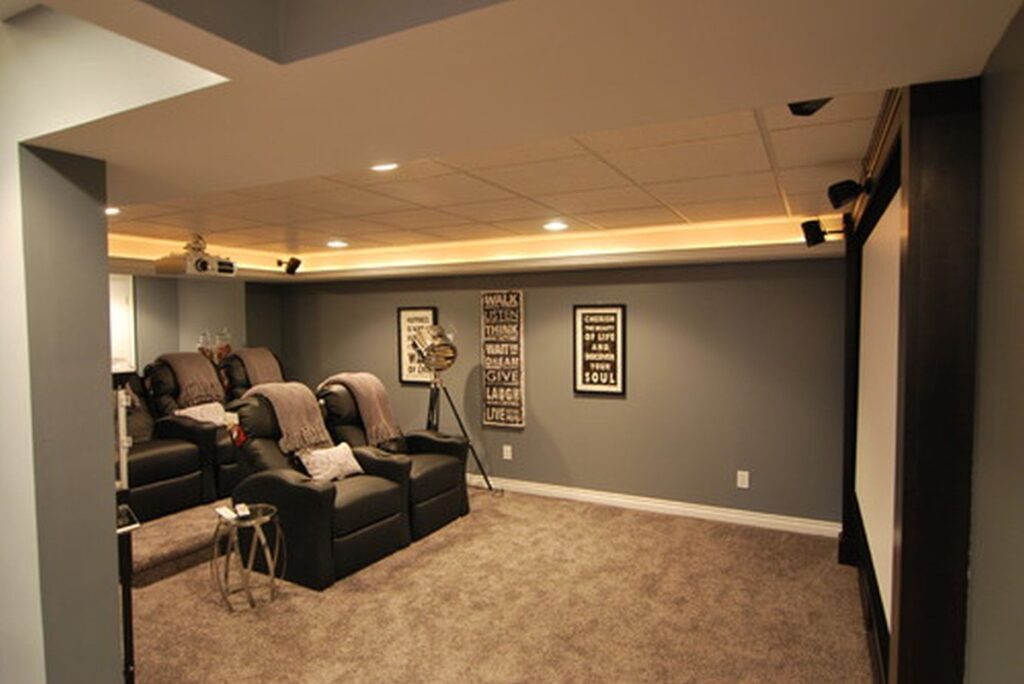
If you absolutely love movies or simply prefer watching them from the comfort of home, adding a home theater might be the perfect addition to your space. You’ll have a dedicated place to kick back with family and friends, watch the next big blockbuster, revisit an old classic, stream a series, or even enjoy the big game.
Home theaters can be top of the line, budget-friendly, and everything in between. Whether you spend a little or a lot, a home theater can still be amazing. The technology has changed quite a bit over the years, but the fundamentals of a great theater have not. You still need to think about the room itself, the acoustics, lighting, seating, video, and audio before choosing all the equipment.
Today, homeowners also have more flexibility. A home theater does not always need to be a dark room with rows of theater seats. Some people still want that traditional experience, while others prefer a multipurpose media room that works for movies, gaming, sports, and everyday entertaining.
Before you get down to the home theater transformation, you’ll need to make sure that you deal with any possible issues. Check out our basement finishing blog to get some tips about how to better prepare for your new media haven. In this other blog, it mentions carpet possibly being a poor choice for some basement spaces, but for a properly prepared home theater room, you’ll still want to consider carpet for acoustic reasons.
Acoustics
When you have a movie playing at a high volume, room acoustics are important to take into account. For a home theater, you will need to properly absorb and control sounds to help your speakers create better sound quality.
When going about creating the best acoustics, you’ll already want to have any insulation put in and all speaker, projector, network, and lighting wires run. Even with more wireless technology available, planning for wiring during construction is usually much easier than trying to add it later.
The room itself matters just as much as the equipment. Hard, reflective surfaces can make even a high-end audio system sound harsh or echo throughout the room. A well-planned space can make a modest system sound significantly better.
Ceiling
If you already have a drop ceiling in your basement, then you are well on your way to your home theater. In order to help keep the audio in and the outside out, you’ll want to pack the ceiling with insulation.
To add to the ambiance, consider painting the ceiling and track black or another dark, low-reflection color. If you don’t have a drop ceiling or don’t want one, you’ll still want to consider insulation and sound control in this space.
If you plan to use drywall, you can also add acoustic-absorbing materials, just like you would on the walls. Homeowners who want more immersive sound may also need to plan for speakers in or near the ceiling, so it is important to decide on your audio layout before everything is closed up.
Walls
Drywall and plaster reflect and bounce sound rather than absorb it. This is the last thing you want while playing your movies.
To fix this, you need some kind of wall covering, and there are several options to choose from. You can simply hang curtains on the wall, which can also give you that classic theater look. You can also get acoustic panels or other sound-absorbing materials to attach to the walls.
These are specifically made to control sound, and they come in different styles that can fit the look you are trying to create. Acoustic treatments no longer have to make a room look like a recording studio. Many options can blend into the design or even look like artwork.
You can also use a combination of these options.
Floor
Flooring for your home theater will be one of the easier parts of your new home theater. After painting, insulating, adding acoustic elements, and finishing the major construction work, you are ready to add carpeting.
You’ll want to do this later in the project because it helps ensure that none of your carpeting gets damaged or painted during the other steps.
When choosing a carpet, the plusher the better from an acoustic standpoint. But it is still fine to get a mid-range carpet. Just try to stay away from super-thin carpeting if sound absorption is an important goal.
Other types of flooring can bounce sound around the room. That does not mean you absolutely need carpet, especially in a multipurpose media room, but harder flooring may require additional acoustic treatment elsewhere in the space.
Lighting
There are several factors that go into having the perfect theater lighting. You’ll want to consider the balance, direction, and control of your lighting fixtures.
Since you’ll already be making your room dark, dimmable recessed lighting can give you proper lighting balance. You can leave the lights on the lowest setting during movies so that you can see better if you get up to go to the bathroom or grab another bag of popcorn.
Light direction is also important since you don’t want fixtures that take away from the picture quality. Recessed lighting, directional lights, wall sconces, and LED accent lighting can all work well when they are positioned so they do not shine directly onto your screen.
One of the biggest improvements in home theater design is how much easier lighting is to control. Rather than just using a basic remote, you can connect lighting to a smart-home system or app. You may be able to create a “movie” scene that dims the lights, closes the shades, and prepares the room with one command.
Accent lighting has also become more popular. Subtle lighting along steps, seating platforms, walls, or behind a screen can improve the experience without making the room too bright.
Windows
If you have a window, you’ll want to invest in either room-darkening shades or blackout curtains.
If you are having movie time when it’s still light out, or there is a lot of ambient light outside because of where you live, the last thing you want is that light from the window interrupting the picture quality.
Motorized blackout shades are another option and can be connected to the rest of the room’s controls. The important thing is having a reliable way to control natural light whenever you want to use the theater.
Furnishing
Think about what kind of seating you want.
If you have a higher budget, think about getting theater seats or specially designed seating for home theaters. If that’s not in the budget, or just not what you want, there are plenty of other options. You can get nice recliners, loveseats, sectional sofas, bean bag chairs, or even an existing couch you already love.
When setting up your seats, think about making sure everyone can see the screen. If you have a large enough space, you can even make a platform to put in a second row of seating.
Otherwise, you’ll want to stagger your seating and put smaller seats or beanbag chairs up front while keeping the larger couch or loveseat toward the back. Recliners are a great option to have forward as well because once they are reclined, they may be less likely to block the view of whoever is seated behind them.
Viewing distance should also be part of the plan before you choose your screen. Today’s televisions and projectors make much larger images possible, but bigger is not always better if the screen overwhelms the room.
Furnishing isn’t just about the seating. Think about how you want to decorate your home theater. This can be anything from your lighting fixtures to movie posters.
If you decided to put curtains up on your walls for acoustics, then you may already be satisfied with how your room looks. You can also install curtain hooks and keep them draped back, then put your movie posters and wall fixtures in between.
Some other great options are usable movie decorations, like a popcorn maker. Or you can build a food and drink station where you can keep drinks, a microwave, and cabinets or shelves for popcorn, candy, or any other snacks you may want.
If your home theater has the space, you can even add a home bar. Read our home bar blog to see if a wet or dry bar would be the best option for you.
Video
The video system is one of the most important parts of your home theater, and this is one area where the options have changed considerably.
You can choose from a large television or a projector and screen. Projectors and screens are still popular for people who want a traditional theater experience, but today’s large-screen televisions can also create an impressive setup.
For most homeowners building a new theater, 4K should be the starting point. Large 4K televisions are more accessible than they once were, and 4K projectors offer another option for homeowners who want a very large image.
Ultra-short-throw projectors have also become more popular. Unlike traditional projectors that are installed across the room or mounted overhead, these can sit much closer to the screen. That can make them easier to incorporate into certain rooms.
Traditional ceiling-mounted projectors are still an excellent option, especially in a dedicated theater where the room can be designed around the equipment.
When choosing between a television and projector, think about the room instead of assuming one option is automatically better.
A television can provide a bright, high-contrast image and work well in multipurpose rooms. A projector can create a much larger, more theater-like experience, especially when the room has strong light control.
For the projector screen, you can buy an actual screen, have one installed as part of the room, or explore other options based on your budget. Take into account the size and shape of your room when choosing a screen size, because too big can be just as problematic as too small.
You should also think about where your content is coming from. Streaming devices and smart television platforms have largely taken over for many homeowners, although Blu-ray and other physical media can still be appealing for people who want to build a movie collection.
Make sure your equipment, cables, receiver, internet connection, and other components can support the picture quality and performance you expect. This is another reason it is helpful to plan the technology before finishing the walls and ceiling.
Audio
There are many audio systems out there that range in price from hundreds to thousands of dollars. You don’t need a top-of-the-line system to get amazing audio quality still.
A traditional 5.1 system can still provide an excellent experience. That generally includes speakers at the front, a center channel, surround speakers, and a subwoofer.
But immersive audio has become a much bigger part of home theater design. Systems can now add height channels through ceiling or upward-firing speakers, allowing sound to feel like it is moving above and around you rather than only from the front and sides.
For some homeowners, that means a more advanced speaker layout. For others, it might mean a high-quality soundbar system that can create a more immersive experience without requiring speakers throughout the entire room.
In-wall and in-ceiling speakers are also popular for homeowners who want great sound without having equipment dominate the design. This can give the theater a cleaner look, but placement needs to be planned carefully.
The next thing you may need is a receiver or other system controller. This allows you to manage audio from your sources and adjust the sound as you see fit.
Some systems can also automatically calibrate the sound based on the room and speaker placement. That can be helpful, but technology cannot completely fix poor room acoustics or badly positioned speakers. The physical design of the room still matters.
You’ll also want to plan for speaker wires and any other connections before the ceilings and walls are finished. That way, the wiring can be tucked away and the room will have a much cleaner appearance.
The best home theater is not necessarily the one with the most expensive equipment. It is the one where the room, lighting, acoustics, seating, video, and sound all work together.
If you are thinking about remodeling your basement, even if you aren’t adding a home theater, Shakespeare Home Improvement is here to help. We are a full-service home improvement contractor here in beautiful Lancaster, PA. Contact us today for a free estimate!